Categories
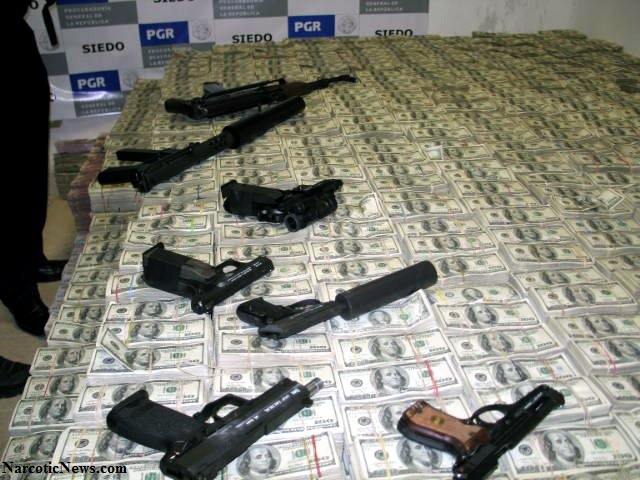
Drugs money worth billions of dollars kept the financial system afloat at the height of the global crisis, the United Nations’ drugs and crime tsar has told the Observer.
Antonio Maria Costa, head of the UN Office on Drugs and Crime, said he has seen evidence that the proceeds of organised crime were “the only liquid investment capital” available to some banks on the brink of collapse last year. He said that a majority of the $352bn (£216bn) of drugs profits was absorbed into the economic system as a result.
Source: Guardian UKDrugs, Intelligence, Middle East
October 28
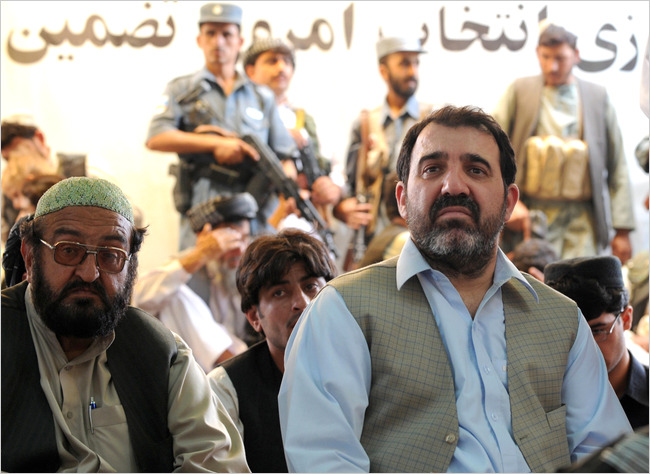
Brother of Afghan Leader Is Said to Be Drug Trafficker on C.I.A. Payroll
Ahmed Wali Karzai, the brother of the Afghan president and a suspected player in the country’s booming illegal opium trade, gets regular payments from the Central Intelligence Agency, and has for much of the past eight years, according to current and former American officials.
The agency pays Mr. Karzai for a variety of services, including helping to recruit an Afghan paramilitary force that operates at the C.I.A.’s direction in and around the southern city of Kandahar, Mr. Karzai’s home.
The C.I.A.’s practices also suggest that the United States is not doing everything in its power to stamp out the lucrative Afghan drug trade, a major source of revenue for the Taliban.
Source: New York Times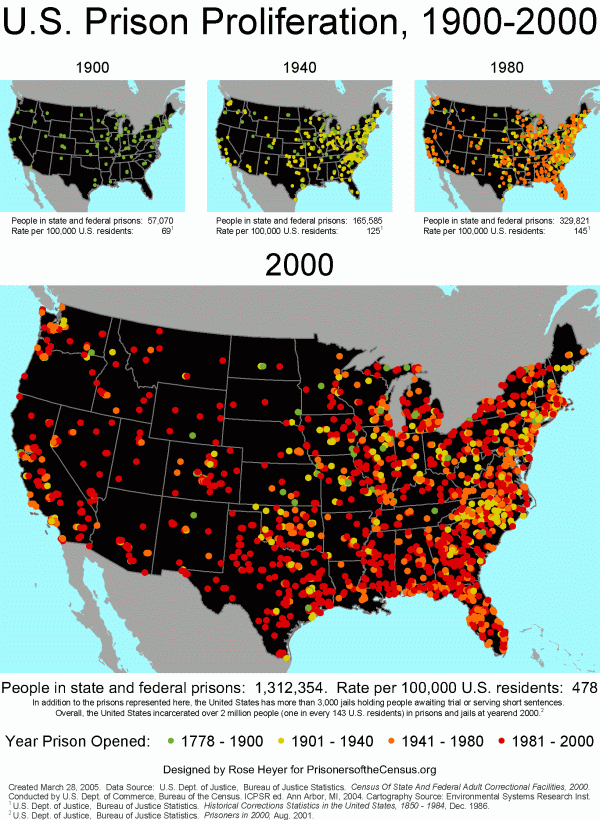
Astonishingly, many politicians seem to think that we should lead the world in prisons, not in health care or education. The United States is anomalous among industrialized countries in the high proportion of people we incarcerate; likewise, we stand out in the high proportion of people who have no medical care — and partly as a result, our health care outcomes such as life expectancy and infant mortality are unusually poor.
It’s time for a fundamental re-evaluation of the criminal justice system, as legislation sponsored by Senator Jim Webb has called for, so that we’re no longer squandering money that would be far better spent on education or health. Consider a few facts:
Source: New York Times
In the face of a growing number of deaths and cases of HIV linked to drug abuse, the Portuguese government in 2001 tried a new tack to get a handle on the problem—it decriminalized the use and possession of heroin, cocaine, marijuana, LSD and other illicit street drugs. The theory: focusing on treatment and prevention instead of jailing users would decrease the number of deaths and infections.
Five years later, the number of deaths from street drug overdoses dropped from around 400 to 290 annually, and the number of new HIV cases caused by using dirty needles to inject heroin, cocaine and other illegal substances plummeted from nearly 1,400 in 2000 to about 400 in 2006, according to a report released recently by the Cato Institute, a Washington, D.C, libertarian think tank.
Source: Scientific American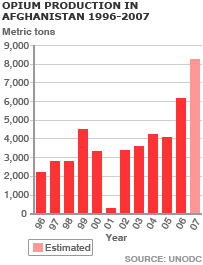
Since the United States invaded Afghanistan, the country’s number one cash crop, opium, has repeatedly broken production records for the country. By some estimates, the occupied territory now supplies by some 90 percent of the world’s poppies.
So far, eradication efforts have merely fueled the Taliban’s coffers and driven civilian farmers further outside of U.S. influence. Because of this, the United States has formed a new strategy in the fight against the crop: They are giving up.
Source: Rawstory